guardian of the Lima estuary
It sits right on the north bank of the mouth of the Lima river, with the ocean on one side and the city a few steps away. The location isn't accidental: it was exactly what determined its existence. In the 15th century, Viana da Foz do Lima was one of the great Portuguese seaports, with active routes to Flanders, Galicia and France. All that movement attracted pirates. The response was to build stone and cannon.
The Forte de Santiago da Barra you visit today is the result of at least three overlapping phases of construction. The oldest, the Torre da Roqueta, is Manueline and dates from the early 16th century. Some researchers point to it as the prototype for the Torre de Belém, built shortly after in Lisboa. In 1589, under the Filipino Dynasty, everything was remodelled and expanded to a design by Italian military architect Filippo Terzi, responsible for landmark works in Portugal and Spain. The population of the town itself had to transport the stone needed for construction. The works were completed in 1596.
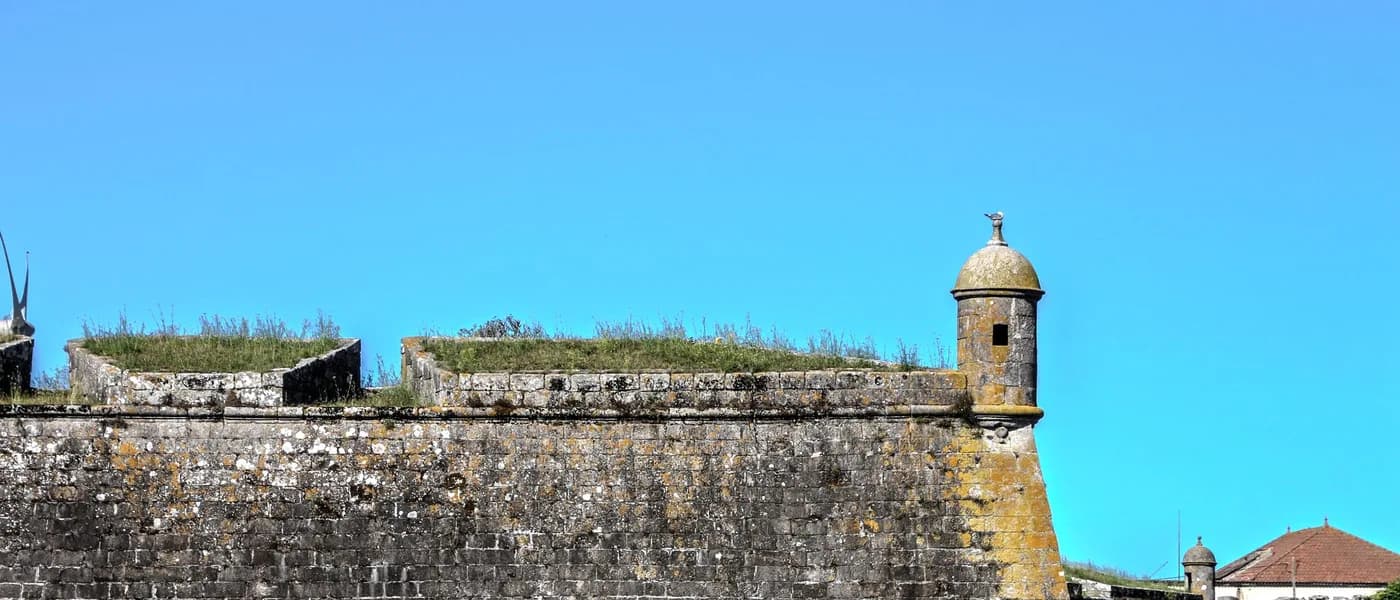
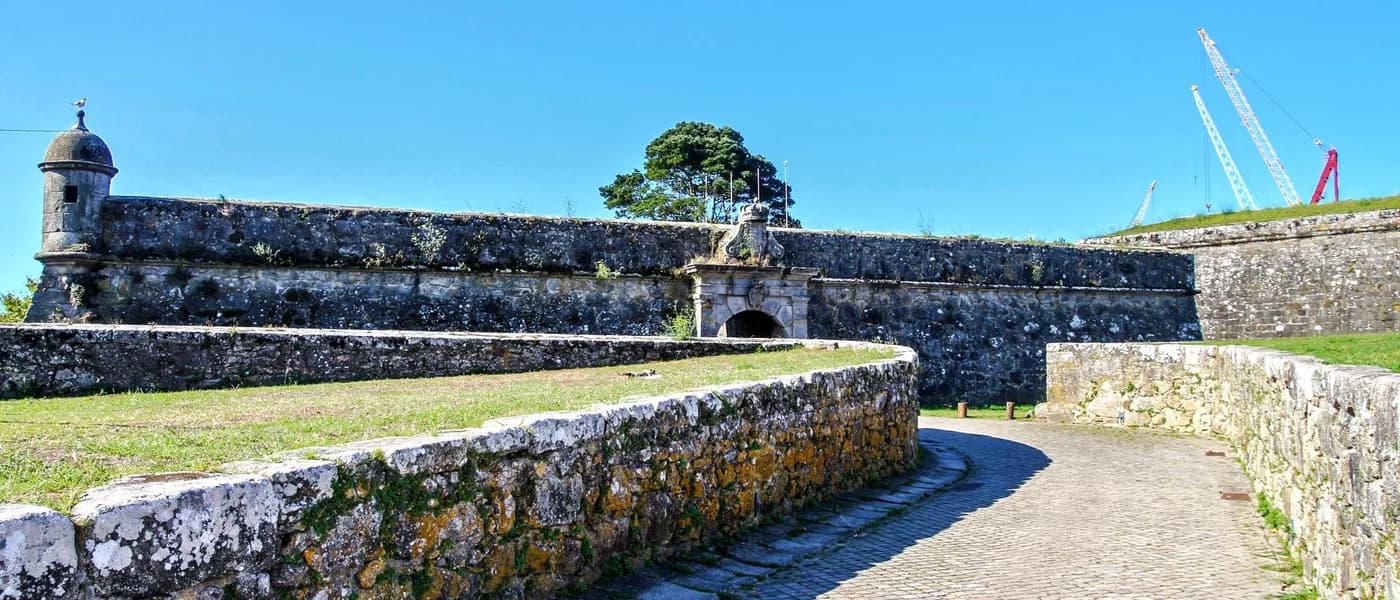
The result is a fortress with a pentagonal plan, trapezoidal-profile walls, triangular bastions at the vertices facing land, circular sentry boxes and a moat surrounding it. Entry is through a wide bridge over that moat, through a portal topped by the coat of arms of D. João de Sousa, governor of the stronghold in 1700. Inside, the main building, the former Chapel of Santa Catarina (now the Chapel of Santiago da Barra) and the powder magazine make up an ensemble that is, in itself, a rapid course in military architecture of the Filipino period.
Today the fort houses the headquarters of Turismo Porto e Norte and the Escola de Hotelaria de Viana do Castelo. The life inside the walls isn't museum life: there are people working, courses running. That changes the experience, makes it less staged. Leaving the fort with the Lima in front and the Atlantic closing the horizon is the kind of framing Viana has and you can't fabricate.
five centuries of layered stone
The Torre da Roqueta is the starting point. Manueline, from the early 16th century, it still holds the Cross of Christ and the armillary sphere. Around it, the Filipinos built a new fortress on top of what existed, using the old structure as the southwest corner. Filippo Terzi, who also worked on the Mosteiro de São Vicente de Fora in Lisboa, signed the design. Nearly a century of military history condensed in a single site.
In 1809, during the French invasions, a Company of Ordenanças was quartered here to contain the advance of Soult's troops. It didn't prevent the occupation of the city, but the episode was recorded. The fort deteriorated through the 20th century. Only in 1983 did it come back into regular use, first with the Região de Turismo do Alto Minho, then with the hotel school. A recovery plan is under way that includes an interpretive centre for the Caminos de Santiago.
what you'll find
- the Torre da Roqueta in the southwest bastion, with original Manueline decoration
- the moat surrounding the fortress, still intact
- the entrance bridge and portal with a 17th-century coat of arms
- the Chapel of Santiago da Barra, of medieval origin, inside the perimeter
- the fort with active life: hotel school running in the barracks


