the landmark you earn by climbing
Seventy-five metres of granite cutting through the Porto skyline. The tower was completed in 1763 with the placing of an iron cross at the top, and since then has dominated the city's landscape with an insistence that no new building has yet managed to counter. Nicolau Nasoni, the Italian architect who designed it, wanted to be buried here. It's hard to find a more direct declaration of love for a building.
The 225 steps that take you to the top of the Torre dos Clérigos are no metaphor for anything: they're 225 stone steps in a tight spiral, with windows that let the city in a bit at a time. At the top, the panorama covers all of Porto and also Vila Nova de Gaia on the other side of the river. The tower was also used as an orientation point for vessels entering via the Douro, which says a lot about the weight it has in the reading of the city from the sea.
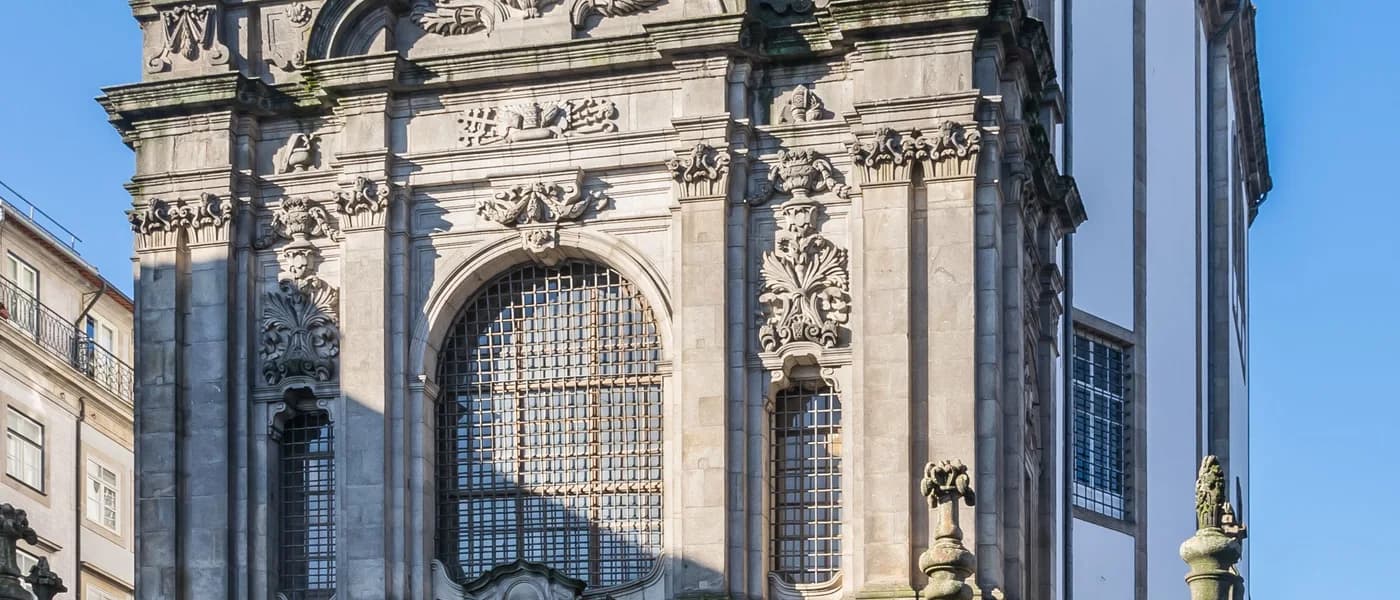
The complex is worth more than the climb. The Igreja dos Clérigos, with its single nave in granite and marble, takes late Baroque to the limit: undulating facades, interrupted arches, a profusion of windows that Nasoni used as his own vocabulary. The Museu dos Clérigos organises the Brotherhood's collection and follows the architect's biography, including the crypt where his burial may be, discovered in a recent restoration. There are also regular pipe organ concerts, which turns an architecture visit into something with sound.
nasoni and the baroque that doesn't repeat itself
The Clérigos complex is considered Nasoni's most emblematic work in Portugal, and you can see why. The style isn't generic Baroque: the granite ornamentation mixes Rococo morphology with lines of vernacular continuity that have no direct parallel in other Portuguese monuments. Granite, a material associated with a certain northern restraint, here appears sculpted with Italian exuberance. The result is a tension you can read in the stone, especially on the main facade.
Nasoni worked on this project for years, committed to it in a way that goes beyond the commission. The Irmandade dos Clérigos, which still manages the complex today, honoured that commitment: when he died in 1773, ten years after seeing the tower completed, he was buried in a small chapel of the church. The National Monument classification came in 1910, but the practical recognition existed much earlier.
what you'll find
- 225 steps to the top, with windows that break the climb into pauses with a view
- panorama over Porto and Gaia including the Douro, the Ribeira and the line of the Foz
- museum with the Brotherhood's collection and a route through Nasoni's life and work
- pipe organ concerts with a regular programme
- crypt with the architect's possible burial, open to the public after recent restoration


