the bridge that isn't by Eiffel, which is just as well
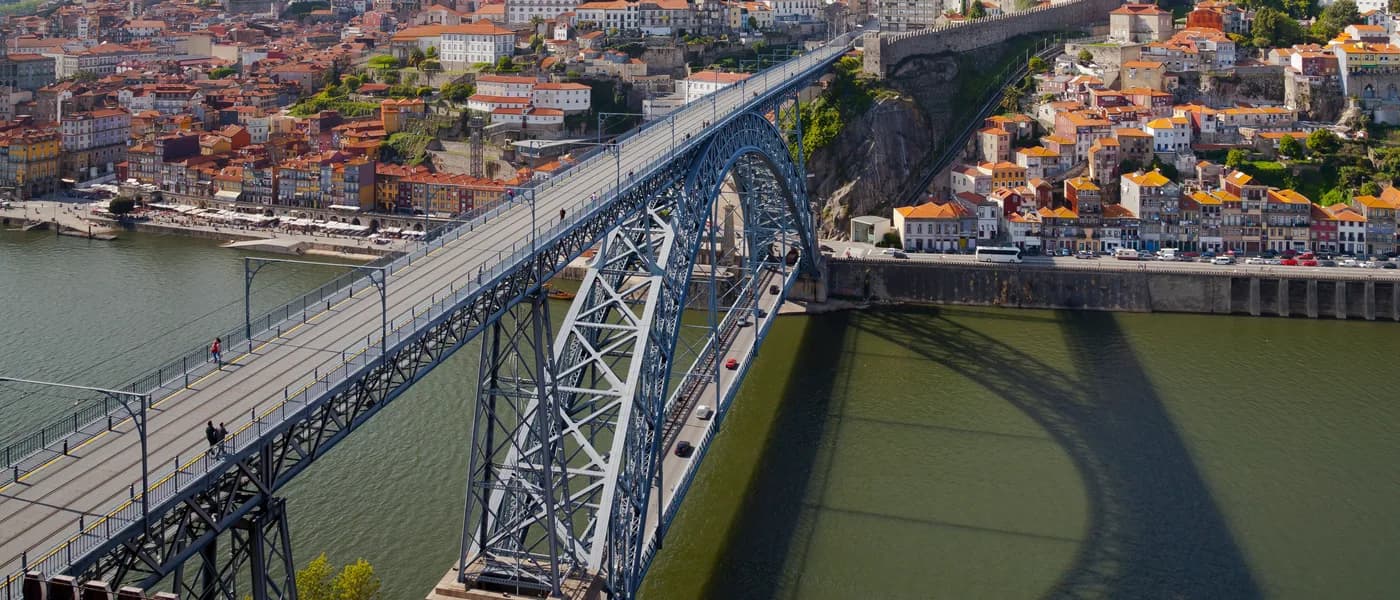
The usual mix-up: many people attribute the Ponte Luís I to Gustave Eiffel. It's not his. The design is by Théophile Seyrig, a Belgian engineer who had worked with Eiffel on the D. Maria Pia railway bridge (that one, further upstream, did have Eiffel directly involved). Seyrig left the Eiffel firm, set up his own company, and won the competition for this one. It was built between 1881 and 1886, with the upper deck inaugurated that year and the lower in 1888.
The structure is wrought iron in a single arch, with a 172-metre span between supports, and was the largest metal arch in the world when it opened. It connects Porto to Vila Nova de Gaia across two decks at different heights: the upper, at the level of the cathedral and the Serra do Pilar monastery, now carries the surface metro and has pedestrian lanes on both sides; the lower, at riverbank level, carries road traffic and has walkways for pedestrians on both sides. Crossing on foot by the upper deck is the thing to do: you walk 60 metres above the Douro, with the Ribeira below and the Gaia wine lodges in front.
The bridge has been a UNESCO World Heritage Site since 1996, included in the historic centre of Porto as a whole. It's not an isolated piece: it's part of the riverside landscape that earned the designation, alongside the cathedral, the Casa do Infante, the Rua Escura, the Ribeira quay, and the wine warehouses on the other side in Gaia. You can see all of it lined up from the upper deck.
Walk across on the top, walk back on the bottom. That's the way it makes sense. From above you get the high view, with the Douro running to the mouth and the Ribeira in miniature below. On the lower deck you cross at river level, with the rabelo boats moored and tourists photographing exactly what you just saw from the other angle. At sunset, with the light coming up the Douro from the Atlantic, the upper deck is the right call.
the whole scene
- two decks: upper at 60 metres over the Douro, lower at riverbank level
- designed by Théophile Seyrig, not Eiffel (though with Eiffel training)
- 172-metre single wrought-iron arch, world record at the time
- UNESCO World Heritage since 1996, part of the historic centre
- crossing on foot is the programme