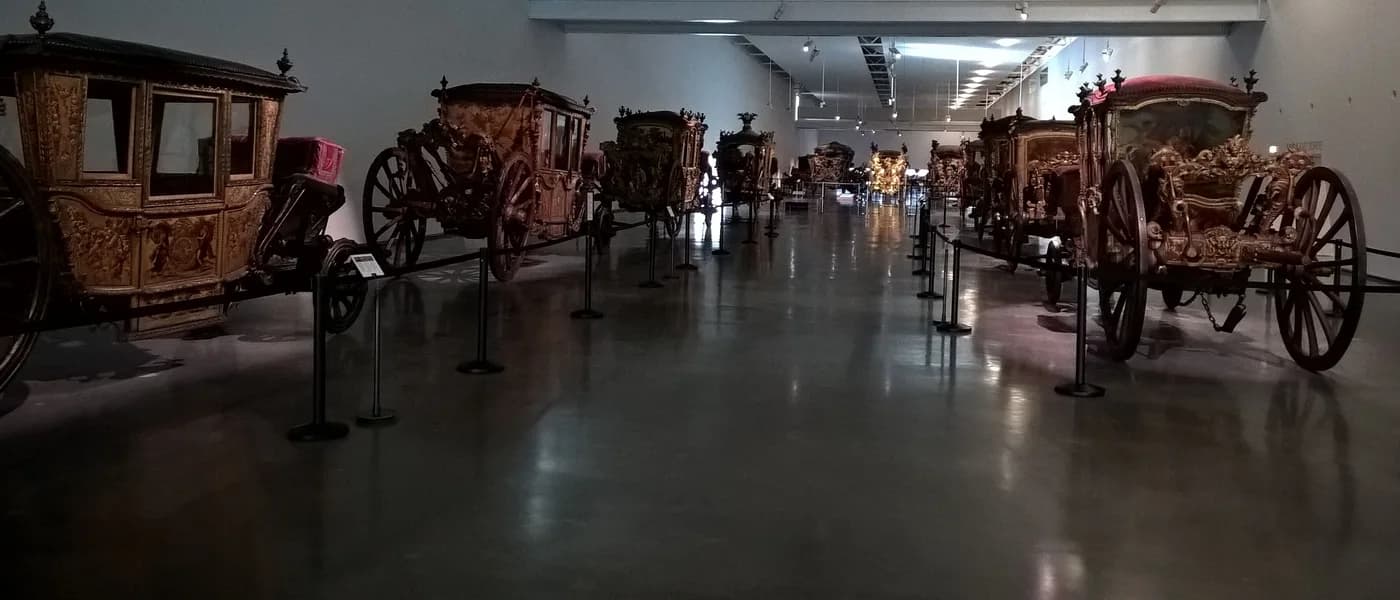
the largest collection of royal coaches in the world, right by the Tagus
It was a queen who set this up. D. Amélia of Orléans and Bragança, in 1905, turned the Royal Riding School of Belém into the world's first coach museum. The idea was simple: gather the carriages of the Royal House before they disappeared, scattered across the stables of several palaces. What wasn't simple was the size of what was being kept.
The Museu Nacional dos Coches today runs across two spaces separated by the same square. The new building, opened in 2015 and designed by Brazilian architect Paulo Mendes da Rocha (2006 Pritzker Prize, in partnership with Ricardo Bak Gordon), holds most of the collection. The original Picadeiro keeps its own section with coaches, berlins and the royal family's painting gallery. They're two distinct registers: an 18th-century historical space and a 21st-century concrete and steel container with animal-drawn artworks inside.
The collection runs to over 9,000 objects. The state carriages dominate, some of them covered in gilded woodwork and oil-painted panels with mythological scenes. But there are also exotic harnesses that arrived as diplomatic gifts: a Mexican silver hunting harness, Algerian harnesses given to King D. Luís by a colonel, a gaucho saddle from Brazil, an Indian harness from Goa. Without meaning to, it's an archive of the network of relations between the Portuguese monarchy and the world.
You leave with a very concrete idea of what it meant to get around Portugal between the 16th and 19th centuries, and of how Belém was, for centuries, the centre of gravity of the power that left and arrived in the country by the river.
the paulo mendes da rocha building
The new building stirred up controversy when it opened. The structure raised on pilotis, with a façade that doesn't communicate easily with the street, struck many as too cold to house such heavily ornamented objects. But the inside works: the controlled natural light, the circulation ramps and the scale of the space let you see the coaches as volumes, not just as museum pieces behind glass.
It's one of the few buildings by a Pritzker laureate in Portugal, and it deserves attention on its own. When you walk the ramps and the coaches appear at different heights, you get that the architect thought about the experience of moving through the space as much as about conservation conditions.
what you'll find
- state coaches with painted panels that are, technically, standalone artworks
- the contrast between the 18th-century riding school and the concrete of the new building
- harnesses and diplomatic gifts from Mexico, Algeria, Brazil and Goa
- queues of school groups in the morning, calmer in the mid-afternoon