in the rain, portugal changes face and almost no one notices
Most people treat rain as a problem to solve. They cancel the walk, run for the café, wait it out. But there are places in Portugal that aren't just putting up with the bad weather: they genuinely get better when the sky closes in. Stone darkens, tourism evaporates, light softens. The country in the brochures isn't this one. This one is quieter, older, and almost always more yours.
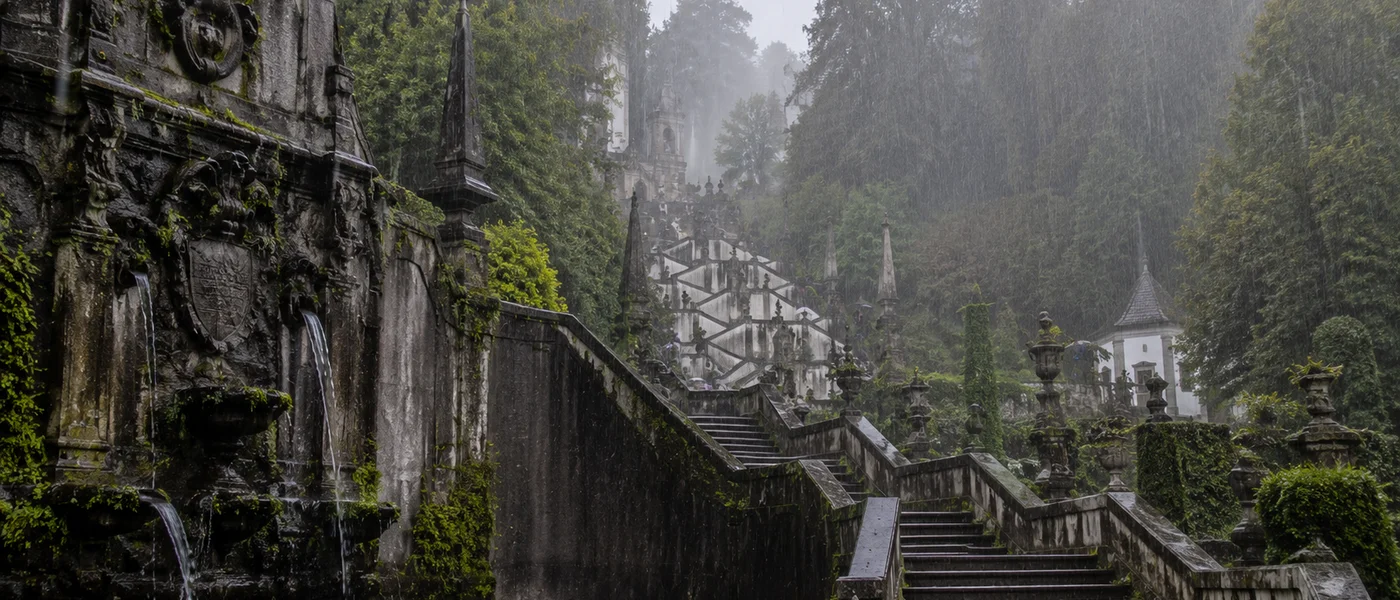
Start with the Santuário do Bom Jesus do Monte, in Braga. Everyone climbs those stairs in the sun and takes the zigzag photo. Do it in the rain. The stone turns black with water, the baroque fountains that usually go unnoticed come alive with run-off, the tourist coaches don't show up. The whole staging was designed to look dramatic, and rain is exactly the ingredient missing on those tidy summer days.
The Biblioteca Joanina, in Coimbra, is another kind of coherence. No humidity gets inside, the climate control is obsessive, and even so you feel the point of the building better when outside the rain is doing what it has always done to Portuguese stone. The gold on the carvings, the shelves that look like altars, the colony of bats that cleans the books at night. All of it makes more sense when the weather outside isn't an invitation to be somewhere else.
The Mercado do Bolhão is covered now, after the works, so the rain doesn't shut it down. But there's a difference: on good days it fills up with people passing through Porto who want to see the iconic market. In the rain, what's left is whoever needs to buy fish, fruit, flowers. It goes back to being what it always was before the renovation put a roof on. Order a coffee, lean against a stall, listen to what's said around you. It's another market.
Further south, the Convento de Cristo in Tomar has eight cloisters and almost none of them is easy to enjoy with the sun beating down. In the rain, the tanks fill up, the gothic plumbing works the way it always has, and you understand that the building was made counting on this weather, not avoiding it. The manueline window is something else when the granite is wet. Set aside at least two hours. You'll want them.
And up in the upper Douro, the Museu do Côa, in Vila Nova de Foz Côa, is the extreme case. The building is a concrete wedge buried into the slope above the river. On a sunny day, it's imposing architecture. On a rainy day, with the valley landscape washed in mist and the terraces glistening, it's almost something else. The palaeolithic engravings down there, out in the open, become impassable in bad weather, but the museum on its own justifies the trip on a day when no one else is heading up to Foz Côa.
The point isn't to escape the rain. It's to pick the right place to have it around you. There are more scattered across the country, on the map you see them all together and find out what catches you along the way. When the forecast says the week is a disaster, remember that's only half the reading.