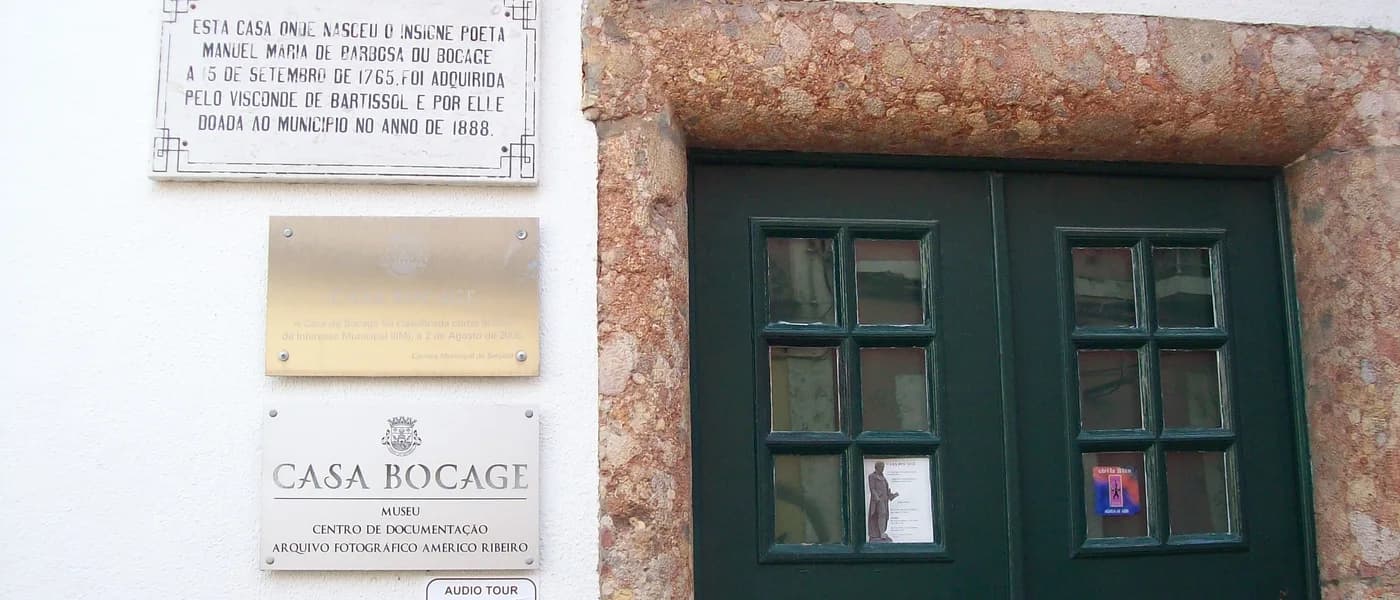
the house where the man who rhymed what couldn't be said was born
September 1765. In a house on the Rua de S. Domingos in Setúbal, Manuel Maria Barbosa du Bocage is born. The poet who would go on to be prosecuted by the Inquisition, censored by the Real Mesa Censória and adored by readers who copied his verses by hand to pass them around.
The Casa de Bocage isn't a museum with imposing collections. It's a contained space: part specialist library on the poet's life and work, part gallery with temporary exhibitions. The Arquivo Municipal de Fotografia Américo Ribeiro also operates here, which gives it a more active double life than most provincial casa-museus.
The history of the building itself carries weight. In 1864, Bocage's fellow townspeople opened a subscription to place a plaque on the façade. Twenty-four years later, a French viscount named Edmond Bartissol bought the house and donated it to the municipality. That's why the street today carries his name and not the poet's. Setúbal has a sense of humour.
You come here more for context than for spectacle. Bocage wrote academic sonnets and obscene epigrams with the same skill, in a city that still insists on claiming him in the streets, in the statues and on the menus in the restaurants in the centre.
what you'll find
- the birthplace of one of the most subversive poets of eighteenth-century Portugal
- specialist library on Bocage, available for consultation
- temporary exhibitions that change throughout the year
- the municipal photography archive in the same space
- a nineteenth-century plaque on the façade


