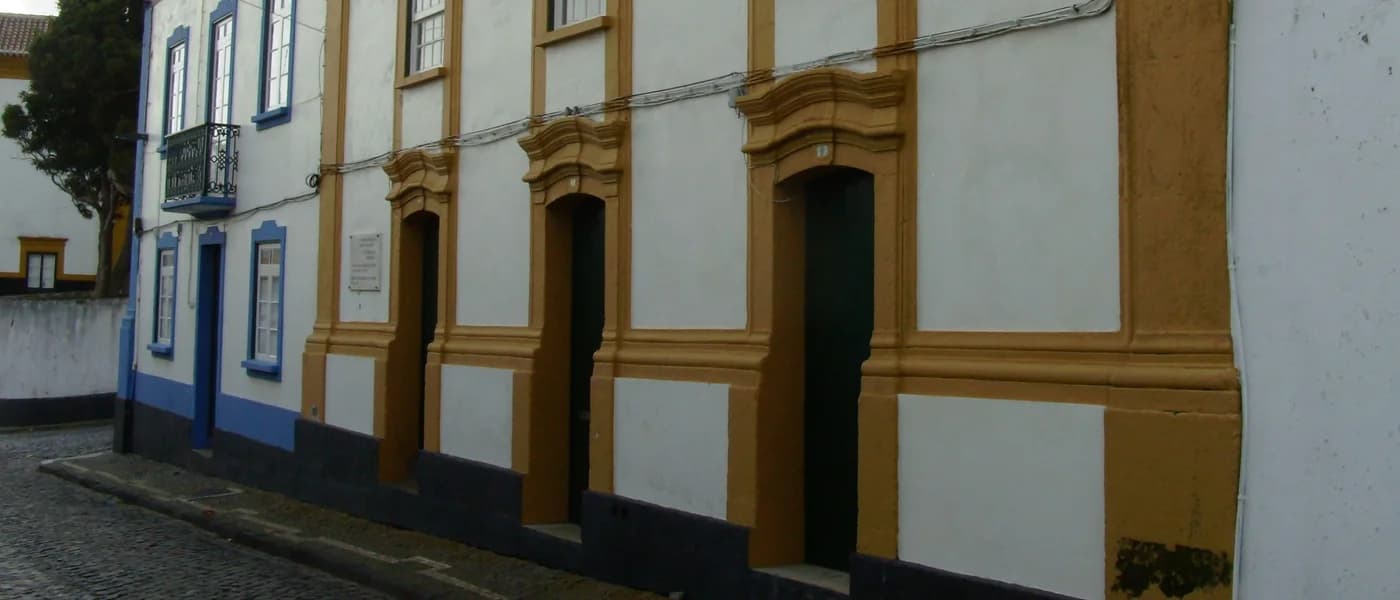
the house where fear wants to be afraid, in terceira
He was born here, on 19 December 1901, the man who wrote Mau Tempo no Canal and gave Portuguese literature a voice that still resonates. The building is from the 17th century, built on the old Rua da Cadeia, and reached our days with its exterior practically intact: exposed stonework, plastered and whitewashed masonry, with few concessions to time.
The Casa-Museu Vitorino Nemésio opened as a museum space in 2007, after a careful refurbishment. Inside you find photographs, objects linked to the writer's work and life, and a multimedia presentation that contextualises who Nemésio was beyond the school canon. There's also a traditional Azorean kitchen that works as a capsule: crockery, utensils, the imagined smell of an island in the early 20th century.
The backyard was turned into a space for recitals and presentations, with old stonework pieces scattered through it. It's a detail that matters: it isn't just a decorative garden, it's an archive in stone. In Praia da Vitória, where the rhythm is different, entering this house is to grasp that Terceira produced one of the most singular voices of the Portuguese language, and that this voice began precisely here, on this street, on this ground.
the voice before the books
Vitorino Nemésio is often reduced to Mau Tempo no Canal, but the house helps recover the rest: the essayist, the poet, the university professor, the television man who for years entered Portuguese homes with an unmistakable presence. The museum's objects and documents cover that whole arc, not just the canonical literary figure.
Terceira runs through everything he wrote. The island isn't a backdrop; it's raw material. Visiting the house where he was born, on a street that still keeps the old name of the Cadeia, is to grasp where that obsession with the archipelago comes from, with isolation, with the sea that separates and connects at the same time.
what you'll find
- a 17th-century house with its exterior preserved for over three hundred years
- the writer's personal and photographic holdings, with biographical context
- a traditional Azorean kitchen intact as a museum piece
- a backyard with old stonework, used for recitals


