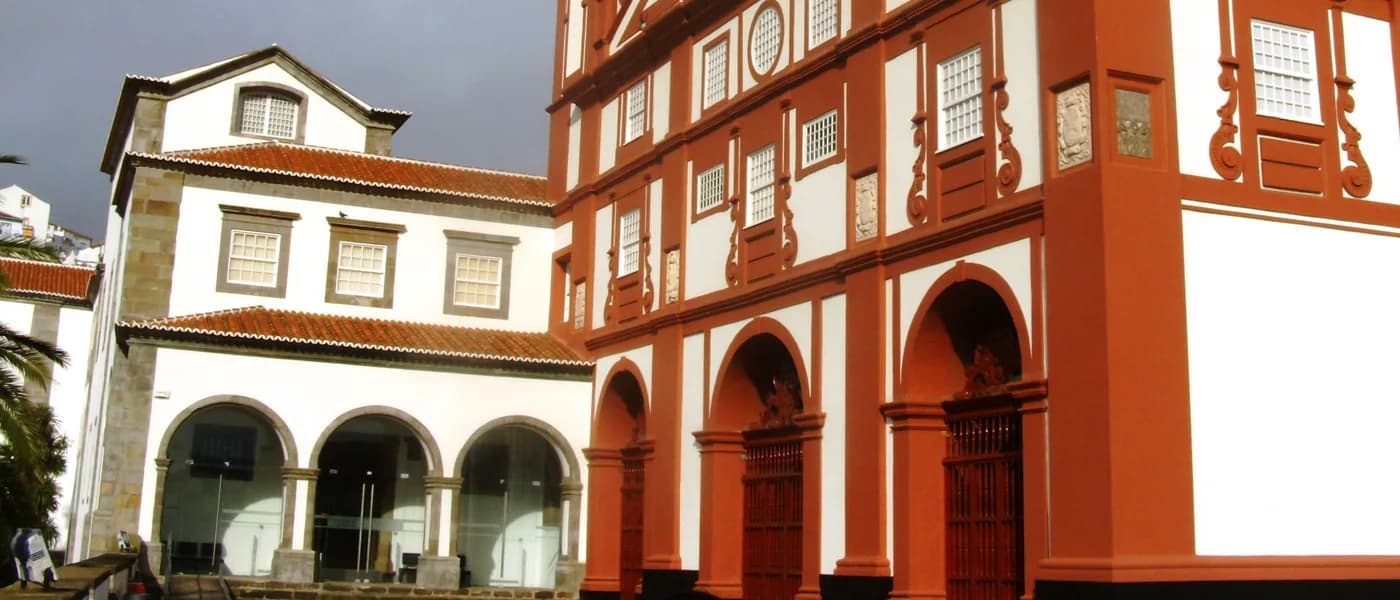
museum, convent and arsenal, all in the same building
There's a 16th-century Franciscan convent beneath all of this. The São Francisco building, headquarters of the Museu de Angra do Heroísmo, accumulates layers of history that go far beyond the displayed pieces: the walls have been a cloister, a barracks, an archive. Today they house a museum that tries to do something difficult, to join the political history of the Azores with the culture that grew inside an island in the middle of the Atlantic.
The museum doesn't do that in a linear way. The main exhibition, "Do Mar e da Terra", uses the Atlantic as a thread and places Angra do Heroísmo at the centre of a history much larger than Terceira: the city was for centuries one of the obligatory stops on the routes between Europe, the Americas and India. That explains the cathedral, the fortresses, the very urban fabric that today is World Heritage.
The museum has three poles spread across the city. The Military History Centre and the Carmina (a contemporary art gallery) are in other buildings, which requires some logistics but also gives a reason to walk through Angra. And the Igreja de Nossa Senhora da Guia, attached to the main building, is used for concerts: baroque music in a former conventual church with stone acoustics is an experience the space justifies on its own.
a programme that doesn't stop
The museum has a regular agenda with concerts, an educational service and rotating temporary exhibitions. The exhibition "Olhar do Outro" runs through portraiture in the permanent collection and gives another perspective on paintings that would otherwise go unnoticed. There's also a partnership with RTP Açores for a programme about the museum, which says something about the scale of the institution for a city this size.
what you'll find
- three distinct poles that ask for at least two visits to see everything
- the Igreja de Nossa Senhora da Guia integrated into the route of the main building
- temporary exhibitions with real rotation, not the same pieces for years
- regular concerts in the church's upper choir, with early music programming
- closed on Mondays, like almost everything in Angra


