nobody's lived up there for decades, and that's exactly why you climb
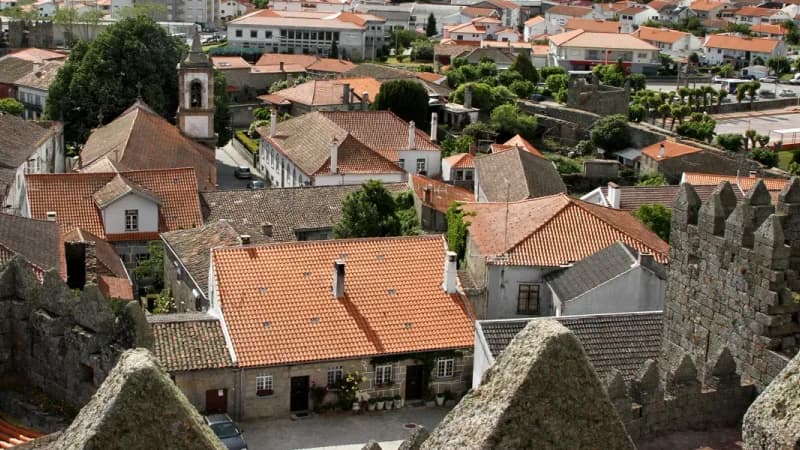
Inside the walls, at the highest point of the crag, nobody's lived there for decades. It's called the Cidadela and it's the part of Marialva you have to climb to see. Up top you'll find the castle with the Torre de Menagem still standing (but fragile, with loose stones), the pillory, the seventeenth-century Casa da Câmara and the Igreja de Santiago, the old parish church.
Marialva has three levels, and that explains the village. At the bottom, the Devesa, by the stream, over what was the Roman city of Civitas Aravorum, is where most people live today. In the middle, the Arrabalde, which grew outside the walls from the thirteenth century with sixteenth-century manor houses. At the top, the empty Cidadela. The read is vertical: life came down from defence to the fields. It's one of the twelve Aldeias Históricas de Portugal and the three-tier layout is what sets it apart.
The history is layered. It was a hillfort of the Araves in the sixth century BC, then the Roman Civitas Aravorum rebuilt under Trajan and Hadrian, then occupied by Visigoths and Arabs, conquered by Fernando Magno de Leão in 1063, who gave it its name. D. Afonso Henriques ordered it repopulated and gave it the first charter in 1179, D. Dinis set up a fair in 1286, D. Manuel granted a new charter in 1512. All of this is still physically marked in the stones you'll walk through.
worth knowing
- the Cidadela is the heart of the visit; it's up there, at the top of the crag
- the Torre de Menagem is still standing but fragile, with loose stones; that's the state of functional abandonment, not a lack of maintenance
- village life today happens in the Devesa, down below; up top it's just ruin and silence
- two nearby Aldeias Históricas to chain in the same day: Castelo Rodrigo to the east, Castelo Mendo to the south