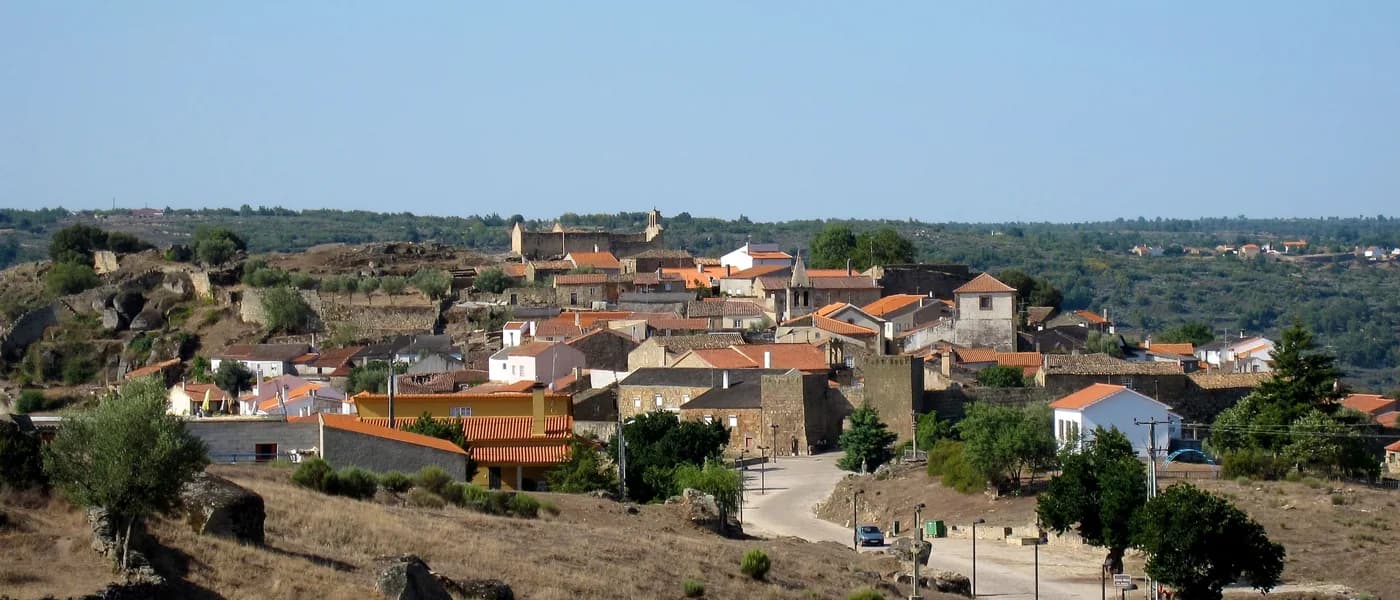
the ruins are the point, and the berrões are the gate
Before you enter through the Porta da Vila, you pass between two berrões. They're granite sculptures representing pigs or wild boars, left there by the Vettones in pre-Roman times. Everything you see beyond them is more recent.
Castelo Mendo was on the Portuguese side of the border with León until 12 September 1297, the day of the Treaty of Alcanizes. Coordinated with Sortelha, Pinhel and Vila do Touro, it faced Castelo Bom and guarded the ford of São Miguel over the Côa. When the border moved east, the town lost its purpose. Today there are fewer than a hundred inhabitants.
The layout has two walled enclosures, the old one and the suburb. The first, from the twelfth century, wraps around the ruined Igreja de Santa Maria, the castle to the south with its perfect-arch gate that separated it from the houses, and the dismantled Torre de Menagem with the cistern beside it. The second, the Arrabalde de São Pedro, got its wall in D. Dinis's reign and took the full force of the 1755 earthquake. It's part of the twelve Aldeias Históricas de Portugal and shares the same municipality with neighbouring Almeida; one is the town that stopped when the border moved, the other is the star fortress that kept defending the border for centuries.
come prepared for
- proper ruins: the Igreja de Santa Maria, the Torre de Menagem, the remains of the castle
- near-total silence, it's a village of fewer than a hundred people, not a tourist site
- bring what you need, don't count on a restaurant or shop inside the walls
- the other historic border village in the district, Castelo Rodrigo, is close enough to chain into the same day


