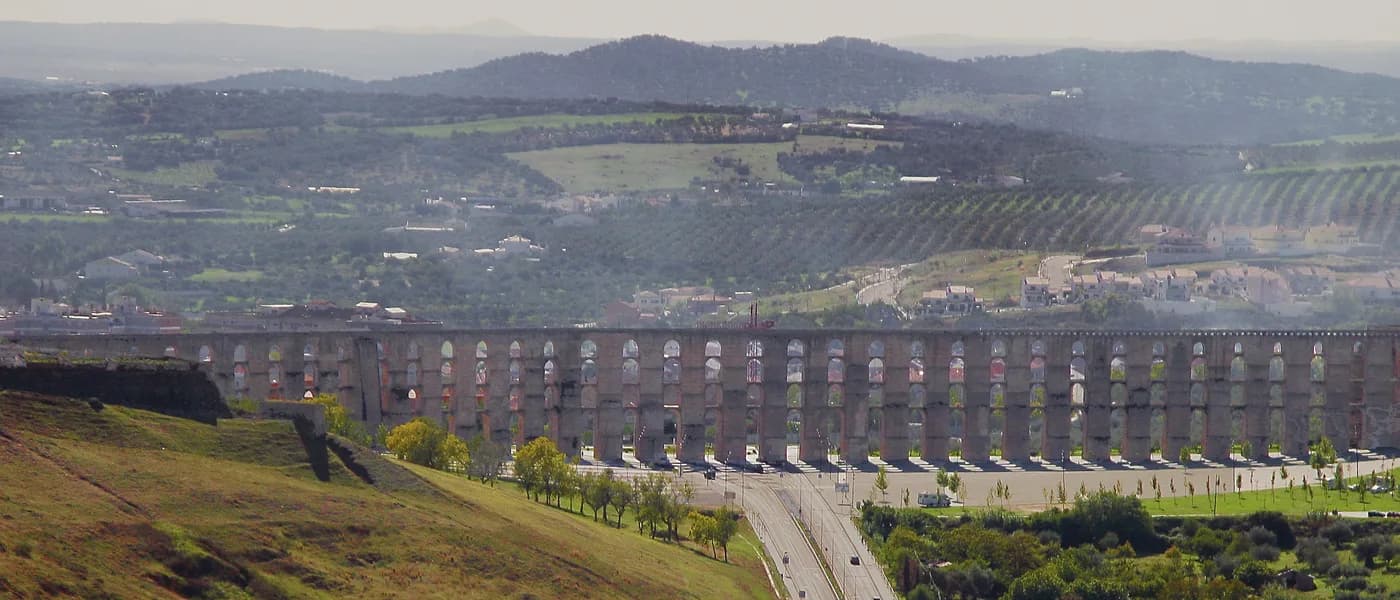
the aqueduct that took one hundred and twenty years to reach Elvas
The Aqueduto da Amoreira is the piece that appears most in photographs of Elvas, and justifiably so: several kilometres of arches crossing the Alentejo plain, with sections where the structure gains four superimposed registers of arches to overcome the height difference, reaching nearly 30 metres. The work began in 1537 and was only completed in 1622, under the direction of architect Francisco de Arruda (the same behind the Torre de Belém and the Aqueduto da Água de Prata in Évora), with subsequent interventions by other architects. It took nearly one hundred and twenty years to carry water from Quinta da Amoreira to the city.
Scale is what makes this aqueduct special. In Elvas the ground drops sharply before rising again to the fortified centre, and it was necessary to build an almost tower-like structure to maintain the water gradient. The four superimposed registers of arches in the highest section create an effect that no other Portuguese aqueduct offers at the same scale. You'll see the thing approaching the city from the road, and before you've even set foot in Elvas you'll already understand what you're dealing with.
The arrival point of the aqueduct is the Fonte da Misericórdia, still in the historic centre, where water continues to flow from springs. The complex is an integral part of the UNESCO classification of Elvas as a Garrison Border Town (World Heritage since 2012), together with the fortifications and strongholds. It's been classified as a National Monument since 1910.
The best way to see it is by circling around the city from the southwest, where the aqueduct ends. There are several angles: from below, with the structure closing the horizon; from a distance, from the top of the walls, with the plain opening up and the aqueduct cutting across it in a straight line. It works at any time of day, but late afternoon, with oblique sun marking the arches against the light, is the time that makes it worth photographing. It pairs well with a visit to the walls and the fort of Santa Luzia, which are just above.
what you'll find
- several kilometres of aqueduct between Quinta da Amoreira and the centre of Elvas
- up to four superimposed arch registers in the highest section, nearly 30 metres
- work begun in 1537 under Francisco de Arruda's direction, completed in 1622
- National Monument since 1910, part of the UNESCO classification of Elvas
- the aqueduct still terminates at the Fonte da Misericórdia, still in use


