an alphabet europe forgot, kept in the baixo alentejo
There are inscriptions in stone scattered across the south of Portugal that no one has managed to fully decipher. They predate Latin, they predate classical Greek as a language of influence on this edge of the continent, and they were carved by peoples who lived here before Rome arrived. The MESA exists for that one subject: Southwestern script, an Iron Age writing system that appears almost exclusively in the territory between the Algarve, the Baixo Alentejo and Spanish Extremadura.
Almodôvar wasn't chosen by chance. The municipality is one of the territories with the greatest concentration of stelae bearing these inscriptions, and the museum was born of that direct closeness to the finds. What you see here isn't a generic reconstruction of peninsular prehistory: it's the story of a writing system that someone invented, used and stopped using, without our being sure what language it transcribed.
The mystery has substance. Researchers have managed to assign phonetic values to a good part of the signs, but the language underneath remains without secure identification. That makes the MESA a museum with an open question at its centre, not with answers wrapped up in panels.
You leave here with the strange sense of having been close to something that really existed, that someone thought important enough to record in stone, and that the Baixo Alentejo kept without meaning to for two thousand five hundred years.
the writing that called everything into question
For decades, it was assumed that writing reached the Iberian Peninsula with the Phoenicians, full stop. Southwestern script complicated that picture. The signs derive from the Phoenician alphabet, but the adaptation is local and the oldest inscriptions may be contemporary with the first Phoenician contacts on the coast, not a late consequence of them. That raises the hypothesis that Late Bronze Age populations of the southwestern peninsula adopted and adapted a writing system very early and on their own.
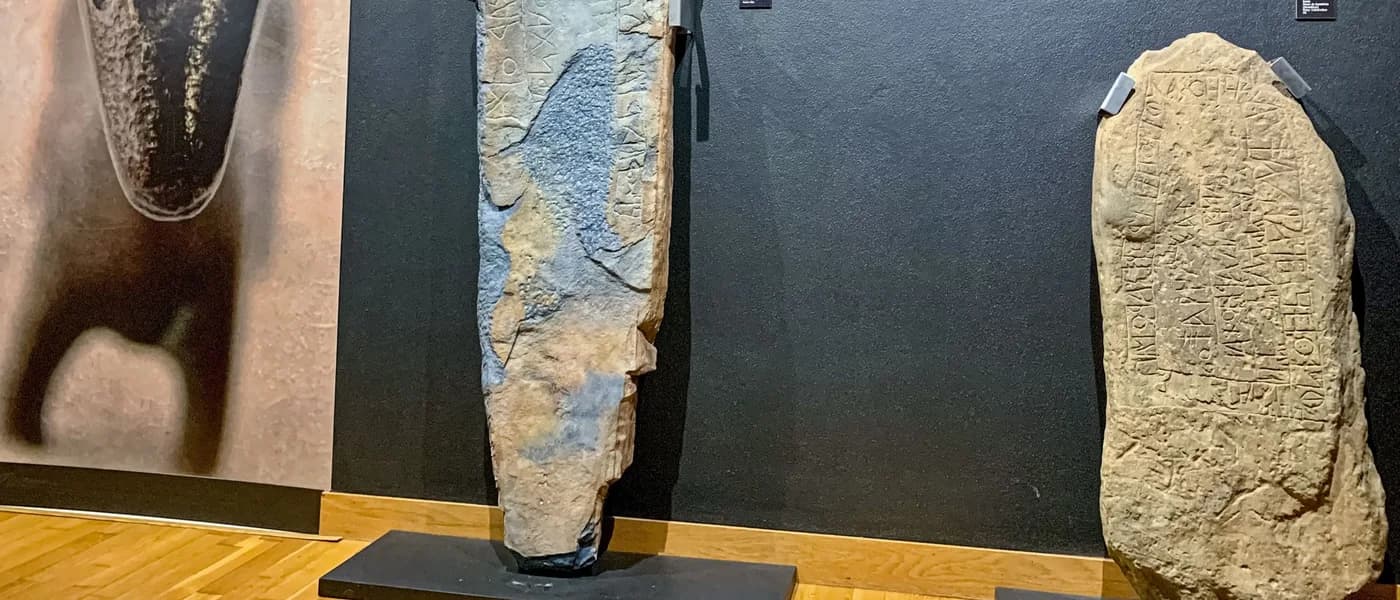
The stelae where these inscriptions appear were, in most cases, funerary monuments. They have schematic human figures, shields, spears and the texts carved into them. Whether they were epitaphs, identifications, or something else, isn't yet known for certain.
what you'll find
- original stelae with the inscriptions, not replicas
- the current state of research presented without oversimplifying
- archaeological context of the municipality and the wider region
- a small but focused museum, with no thematic scatter