where the border has walls and the river is the witness
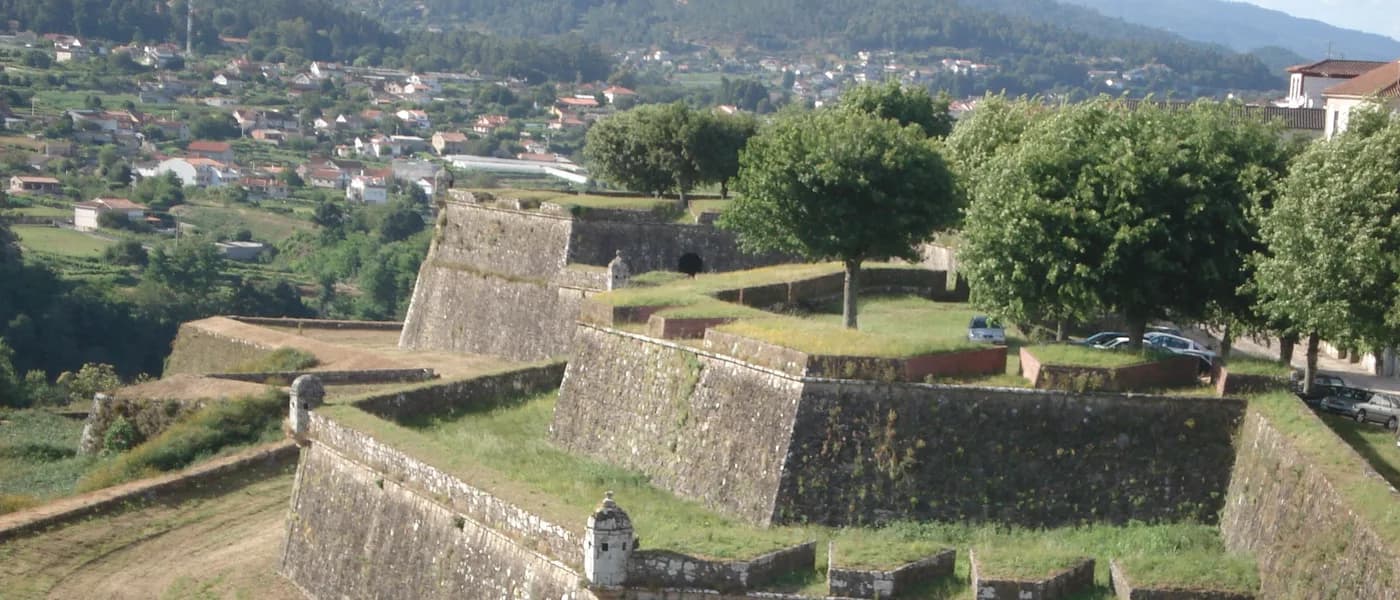
Five kilometres of walls crown two hills above the Minho, with Tui right opposite on the Galician side. It's not a contemplative ruin or a castle shut tight: the fortress of Valença has houses, churches, shops and people living inside its bastions, as it always has.
The occupation of this hill predates Portugal. The Romans used the site as a strategic castellum above the Minho crossing, then came Suebi, Visigoths, Moors, Leonese and Portuguese kings. D. Sancho I took Tui in 1186 and the stronghold accumulated layers. What you see today, though, was shaped in the 17th and 18th centuries: it's the bastioned system that the Count of Castelo Melhor had built to a design by Michele de Lescole, later refined with the model of Marshal Vauban. It's one of the most complete examples of this school on the Iberian Peninsula.
two squares, one fortress
The structure divides into two distinct polygons: the Magistral, the older enclosure where the historic centre sits, and the Coroada, separated by a moat with false brays. In total: 10 bastions, 5 ravelins, 34 sentry boxes, 214 embrasures. Each element had a precise technical function in the system of crossfire that made the stronghold almost impregnable. It capitulated only once to external forces, when General Soult's troops took it in 1809, during the French Invasions. In 1912 it still repelled the monarchist incursion of Victor de Sepúlveda. National Monument since 1928.
Inside the walls there are churches like Santa Maria dos Anjos and Santo Estêvão, the Fonte da Vila, powder magazines, the Aljube and the Portal Champalimaud. The Minho river and the medieval cathedral of Tui form the horizon to the west. It's the kind of place where you walk along a stretch of wall and, without planning it, find yourself looking down at Spain from above centuries of border.
what you'll find
- two walled enclosures with a moat between them, to walk through on foot
- sentry boxes, embrasures and ravelins with the Minho as backdrop
- a living historic centre inside the walls, with shops and churches
- a direct view over Tui and the bridge linking the two countries
- intact Baroque military architecture with Vauban lines