where sephardic memory outlived the walls
A 15th-century synagogue that was never demolished or converted into a church. In Tomar, that's almost a miracle. The building held on, was a warehouse, was a prison, was a granary, but the stone stayed. Today the Museu Luso-Hebraico Abraham Zacuto sits in that space and tells the story of the Portuguese Jews before the expulsion of 1496.
The name honours one of the greatest astronomers and mathematicians of his time. Abraham Zacuto was born in Salamanca, worked in Tomar under the protection of D. João II, and his astronomical calculations were used by Vasco da Gama on the voyage to India. He didn't stay long: the expulsion caught him like the others. The museum doesn't let that irony slip.
Inside there are funerary slabs with Hebrew inscriptions, liturgical objects and documentation on the Jewish community that lived in this city for centuries. The main room of the synagogue, with its four central columns, keeps the original proportions and that's what holds your attention before any display case. You're looking at Portuguese Gothic architecture built for a completely different rite, in a Portugal that later tried to erase the whole chapter.
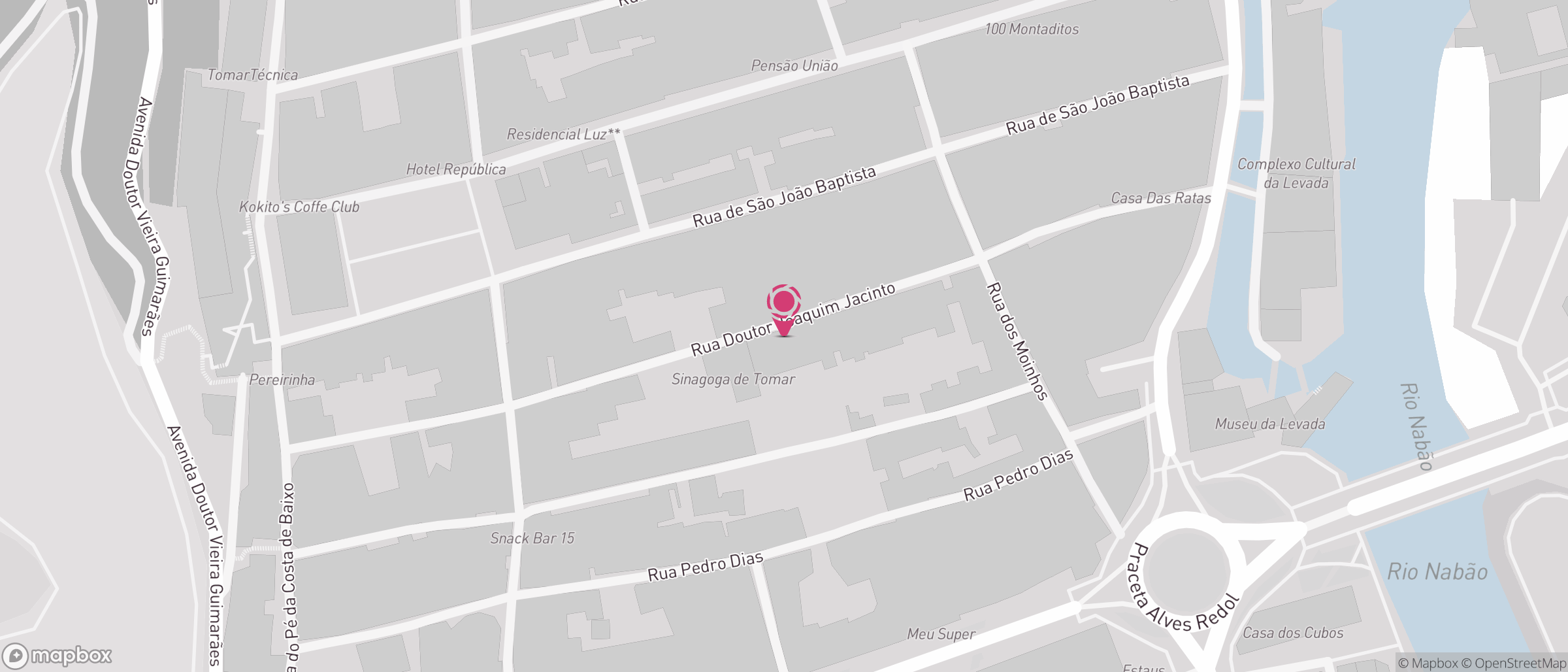
Tomar had one of the most organised Jewish quarters in the country, with its own street and documented community life. Walking out of the museum and a hundred metres further is enough to see that the urban grid is still there.
what you'll find
- the best-preserved medieval synagogue in Portugal
- Hebrew slabs recovered from various parts of the city
- the context of Zacuto explained with rigour, without romanticising
- a small building that weighs more than it looks