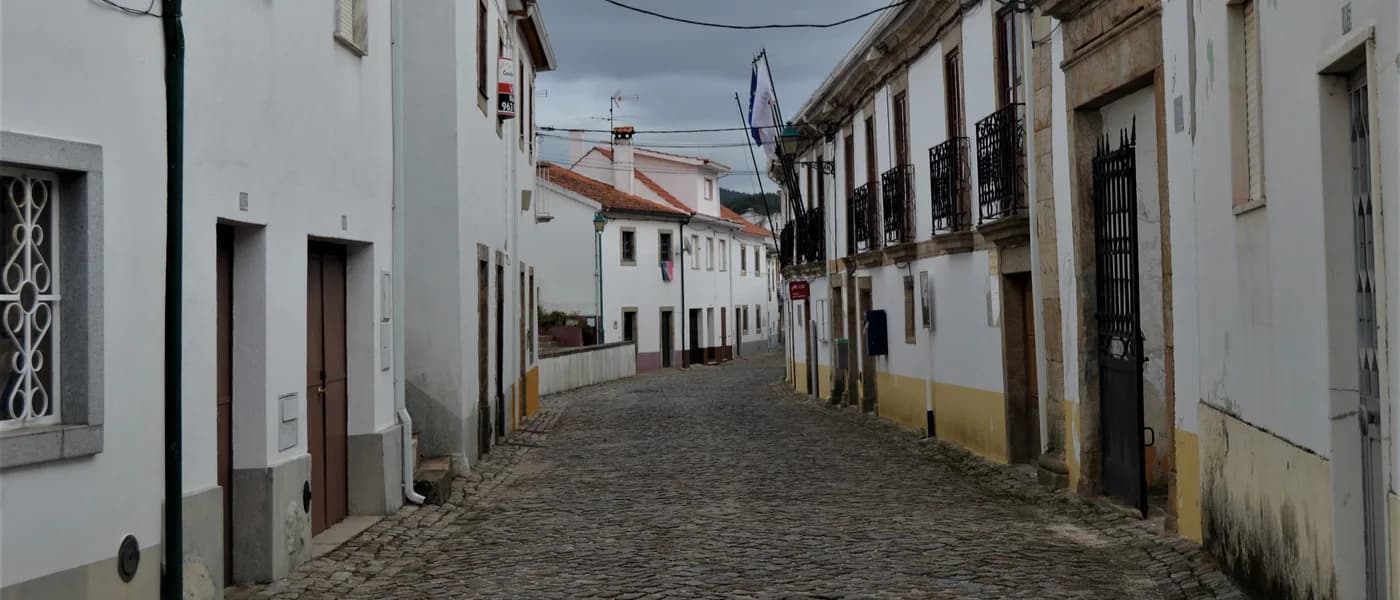
the granite island in the middle of a schist sea
The name says it all. Pedrógão is the granite outcrop that interrupts the dark schist of the whole Zêzere valley here. The village sits on that granite and was built with it: so, unlike almost all the other villages of the Xisto network, this one isn't dark. It's white, with protruding stonework marking doors and windows, and the schist that was actually used in the walls is hidden under whitewashed render.
Pedrógão Pequeno was its own town until the administrative reform of the 19th century, when the municipality was dissolved and the parish transferred to the Sertã. Before that, it was a mandatory crossing on the Zêzere. The Ponte Filipina, built between 1607 and 1610 on the site of a Roman bridge, was for more than three centuries the only link between the Beira Baixa and the Beira Litoral here. It's classified as a National Monument, with three granite arches and a 72-metre deck. It can still be walked across. The Roman bridge it replaced ended up underwater with the reservoirs of the dams downstream.
On the Monte de Nossa Senhora da Confiança, overlooking the village, there are traces of Iron Age occupation, and from the top you can see the white village below and the Zêzere valley stretching on both sides; it's a viewpoint for the end of the afternoon. The Praia Fluvial do Cabril, on the reservoir of the big dam, is the nearest stop for swimming. The rest of the Zêzere continues south from here, and Pedrógão Pequeno remains the gateway out of the schist sea.
good to know
- white village because of the granite outcrop; the schist is hidden under the render
- the Ponte Filipina (1607-1610) is a National Monument, walkable
- the Monte de Nossa Senhora da Confiança is a viewpoint over the Zêzere valley
- the Barragem do Cabril is a short distance away; it's one of the largest dams in the country


