the factory the sardine built
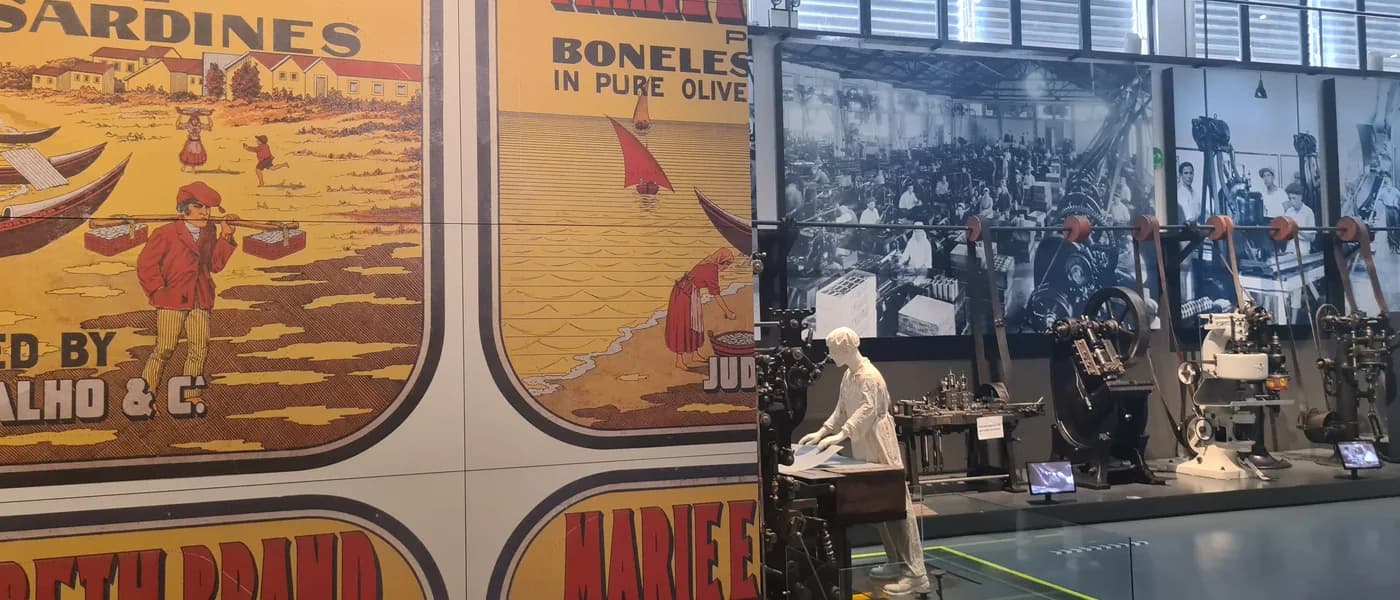
Come in through the old fish-unloading area and you immediately get that this wasn't always a museum. The heading room, with the brine tanks still in place and life-size mannequins reconstructing the work, has a concrete weight most industrial museums can't fabricate. The smell is gone, but the geometry of the work stayed.
Feu Hermanos started in 1889 and the factory opened in 1902, becoming one of the largest industrial units in the Algarve at a time when Portimão lived almost entirely off the sardine. When it closed in the 1980s, it sat idle for decades until the council bought it and decided the building deserved another fate. The Museu de Portimão opened in 2008, in the same walls where the tins were printed with the lithography you can still see in the central nave.
In 2010 it won the European Museum of the Year Award. In 2011, the German DASA prize for the best museums of work. It's not brochure talk: it's recognition that the museum programme here has real substance, from the archaeology of Alcalar to historic vessels like the Portugal Primeiro of 1911, moored since 2023 at the Cais Gil Eanes, right in front.
It sits on the banks of the Rio Arade, and when you leave with your head full of canning and nets, the river is still there on the same side where the trawlers used to unload. Portimão makes more sense after you've entered this building.
the factory from the inside
The logic of the space follows the original production circuit: the route you take is the one the sardine took, from unloading to canning. It's not decorative reconstruction. The mechanical transport systems, the tanks, the metal-sheet printing machine, the "full" and the "empty" rooms (the can-making unit that was across the street, linked by rails) are integrated into the narrative with industrial coherence.
The collection goes beyond canning: shipbuilding, fishing, lithography, foundry, tin work, smokehouses, underwater archaeology of the Arade and a section dedicated to Manuel Teixeira Gomes, writer and President of the Republic born in Portimão. There are also pieces from the megalithic site of Alcalar, which the museum manages as an outdoor branch.
what you'll find
- life-size mannequins reconstructing the work in the heading room
- the lithographic metal-sheet printing machine, original to the factory
- the Portugal Primeiro vessel of 1911, moored on the waterfront
- underwater archaeology of the Rio Arade, including a Roman coin found in 1970
- temporary exhibitions and a 171-seat auditorium with active programming


