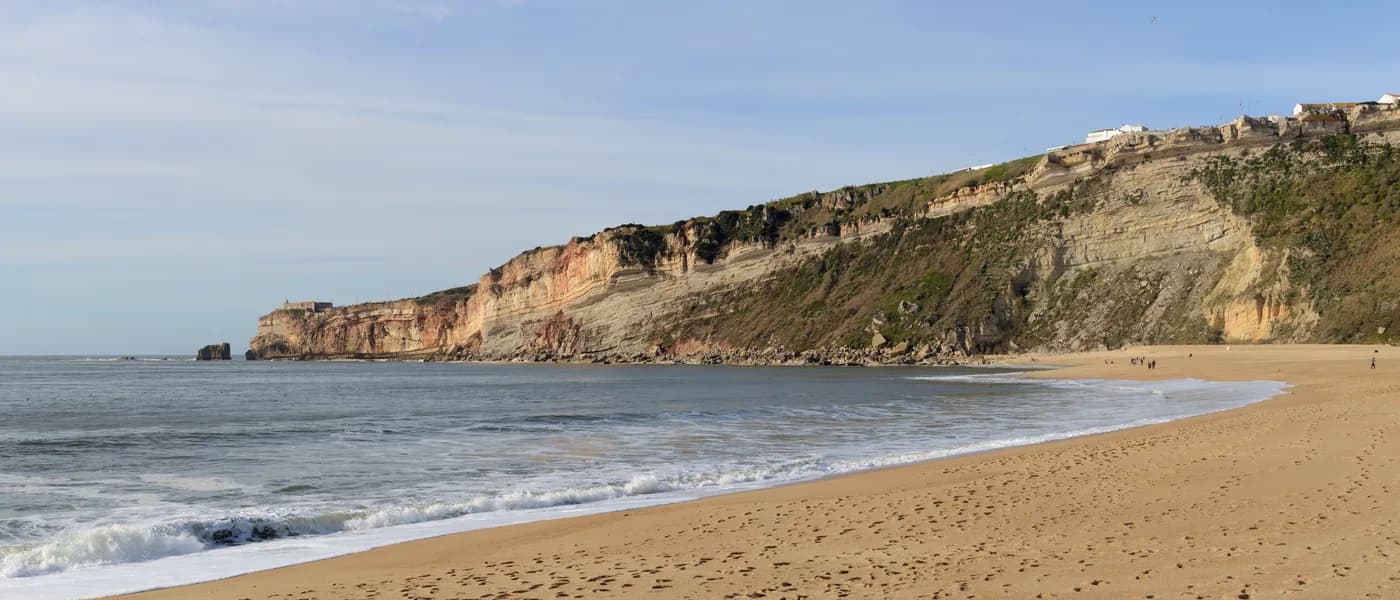
the beach you picture when you think of Nazaré
There's a promenade lined with colourful beach huts, a long stretch of sand and a sea that hits here with particular force. This is Nazaré's most famous calling card, separated from the upper village by a funicular that climbs to the Sítio. The whole thing is practically impossible to ignore.
Praia da Nazaré sits at the foot of a headland that alters how waves behave along this entire stretch of coast. The same underwater canyon that feeds the giants at Canhão da Nazaré, a few kilometres north at Praia do Norte, makes itself felt here in a sea that's rarely tame. Even outside the extreme surf season, the Atlantic makes clear who's in charge.
What sets this beach apart from others isn't the sand or the length. It's the context: the urban strip pressed right up against the shore, the varinas (the fisherwomen who carried their catch on their heads) who still work the area, the contrast between mass tourism and a local life that refuses to lose its own rhythm. Fifteen consecutive years of Blue Flag and an accessibility setup thought through in detail, with boardwalk corridors covering the beach from end to end and amphibious chairs for anyone who wants to get into the water.
You come here and realise that Nazaré is one of the few Portuguese coastal towns where the sea is still the centre of life, not just backdrop.
what nobody notices
- the Sítio headland, right above, completely changes the perspective of everything you see down here
- the accessibility is among the most complete in the country, with 25-metre roll-out mats that reach the waterline
- Portuguese man-o'-wars occasionally show up along the coast, worth checking alerts before you go in
- the underwater canyon that creates the giant waves starts right out there offshore