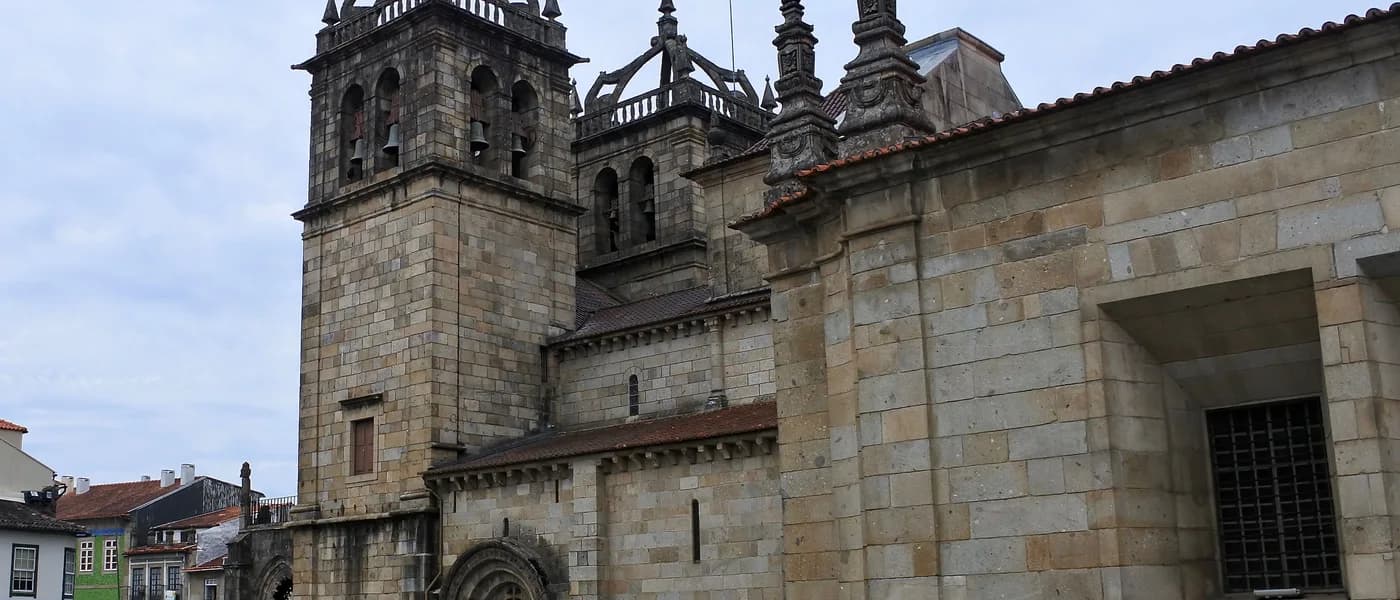
the cathedral is older than portugal
Construction began at the end of the 11th century, under Bishop D. Pedro. It was built over the remains of an earlier structure, and archaeological traces of that temple are still preserved under the chancel floor. When the cathedral was started, Portugal didn't yet exist as a country: the kingdom was born half a century later.
The building has accumulated centuries without hiding them: the original Romanesque body, Gothic chapels from the 14th and 15th centuries, a Manueline porch at the main entrance, Baroque gilded woodwork everywhere. Each style came in at the moment it was in use, and the church was never forced to pick one.
Inside, two 18th-century pipe organs flank the nave: the one on the Gospel side dates from 1737, the Epistle side from 1739. The chapels hold the tombs of Henrique de Borgonha and Teresa de Leão, parents of D. Afonso Henriques, and of Infante D. Afonso, son of D. João I. The cathedral still follows the Rite of Braga, an ancient Latin liturgical rite specific to the Archdiocese.
The Tesouro-Museu, in the old Chapter House next door, holds centuries of the Archdiocese's sacred art, including the cross from the first mass in Brazil, carried by Pedro Álvares Cabral. Leaving through the Porta Nova is continuing the city where the cathedral began.
what you'll find inside
- the late 11th-century Romanesque body, still visible
- the Manueline porch at the main entrance
- the two 18th-century pipe organs, from 1737 and 1739
- the chapels with the tombs of Henrique de Borgonha, Teresa de Leão and Infante D. Afonso
- archaeological remains of the earlier temple, under the chancel floor


