bracara augusta beneath your feet
Braga was, for centuries, one of the biggest cities of the Roman empire in the western Iberian Peninsula. Bracara Augusta, founded by Augustus, had a forum, baths, a theatre, necropolises, a road network that structured the whole northwest. The Museu D. Diogo de Sousa exists precisely to keep what kept surfacing, and what kept coming up in the works of the modern city.
One of the starting points of the museum is a Roman mosaic you can visit at the exact spot where it was found, underneath the building. It isn't a reproduction or a reconstruction, it's the original pavement, in its place. Few museums in Portugal have anything comparable in terms of physical continuity between the excavation and the visit.
The milestone collection is what most sets this museum apart at a European level: the collection is considered the most complete on the continent. They're granite markers that signposted the Roman roads, with imperial inscriptions, many of them classified as a National Monument since 1910. There's an outdoor garden dedicated to them alone.
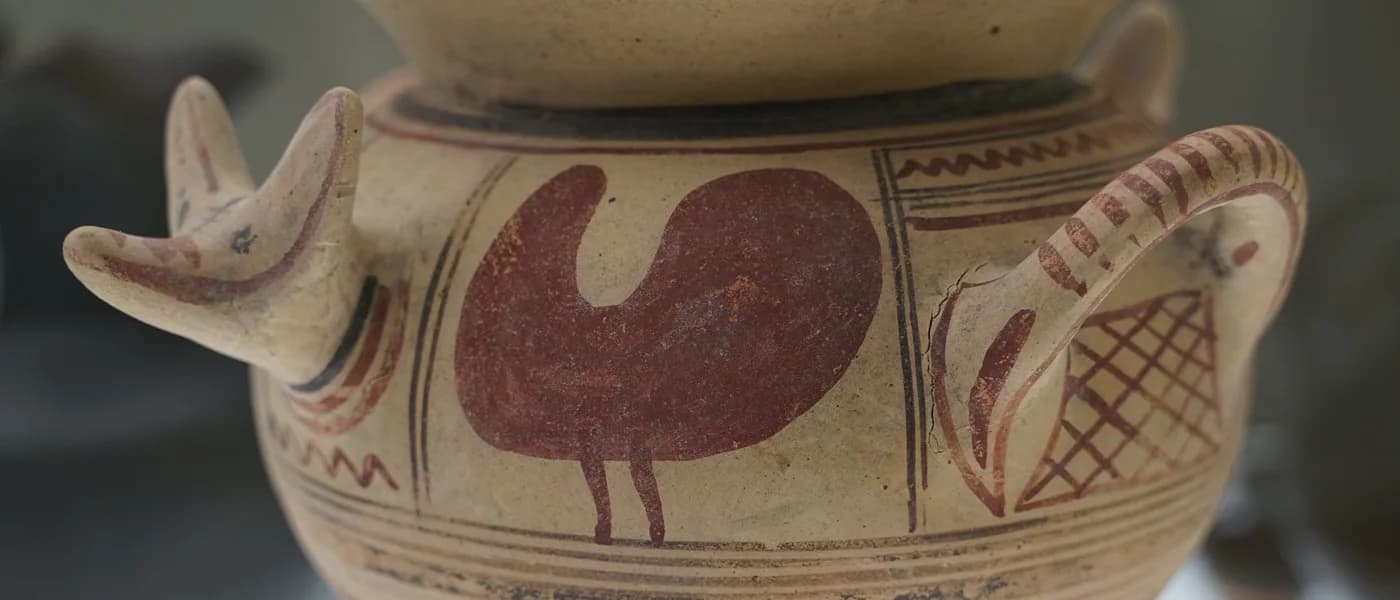
Among recent acquisitions, an international donation brought in pieces that normally only exist in large private collections: a bust of Emperor Augustus from his own time, unique in Portugal, busts of Trajan and Antoninus Pius, marble sculptures, Greek and Etruscan pottery, mosaics. The scale of the collection has shifted substantially in the last decade. If you were last here more than five years ago, the museum you walk into today isn't the same one.
from the palaeolithic to the medieval, with no jumps
The permanent exhibition covers a chronological arc that goes from the Palaeolithic to the Middle Ages, with a focus on the northwest of the peninsula. It isn't a generic collection of "antiquities": it's anchored in the region, in the sites, in the local cultures. The Iron Age section, for example, deals with the world of the castro peoples through pieces directly tied to the Minho and Trás-os-Montes territory.
The Roman period is split into several thematic sections: the urban space of Bracara Augusta, the road network, death and religion. The last one includes a votive altar dedicated to Ocaere, a pre-Roman indigenous deity, found in the 18th century during works at Campo do Gerês. The fusion of Romanisation and local cult is made material in a single stone.
come prepared for
- the milestone garden, which a lot of people walk past quickly without grasping what they're looking at
- the Roman mosaic in situ, on the lower floor
- the bust of Augustus from the imperial period, in a room that doesn't announce what it holds
- large-scale marble sculptures that arrived via a German private donation


