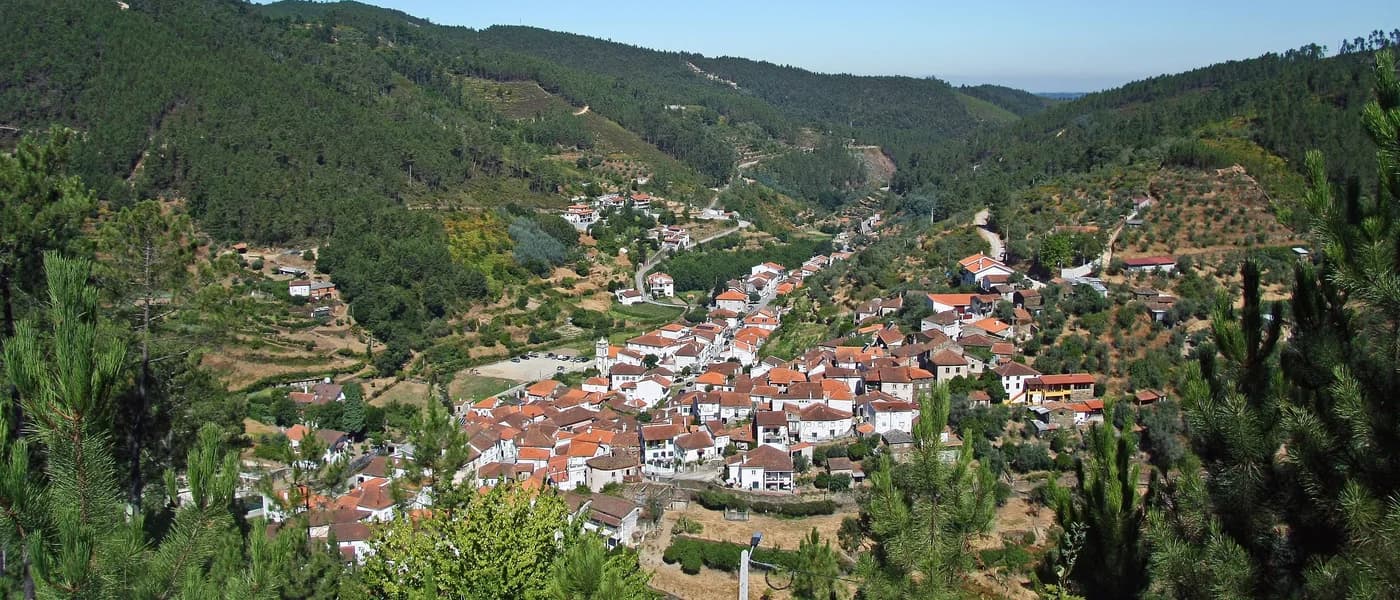
the village where peace arrived before the radio did
On 7 May 1945, before the news reached Portuguese radio, a phone call warned Benfeita that Germany had signed the armistice. The call came from an employee of an English company, married to a woman from Benfeita. The bell tower, built on the initiative of local lawyer Mário Mathias, was in its final stages of construction and the bell had just been put in place. They climbed up and rang it by hand. That was the moment the news entered the mountain valleys.
The tower was originally called Torre Salazar. After 25 April it became the Torre da Paz. It's in schist, square plan three metres to a side, eleven metres tall, with a granite dome and two bells. The original bell weighs only six kilograms and has an indelible inscription: "este sino tocou pela primeira vez a anunciar o fim da guerra da Europa em 1945". Since then, every 7 May the ritual repeats without fail: 1,620 strokes, one for each day the war lasted. The whole village in silence, three hours of counting.
Benfeita is one of the white villages of the Aldeias do Xisto network. The houses are in schist, but most are plastered and whitewashed, giving the village the brightness that sets it apart from its neighbours. It sits on the Serra do Açor slope, crossed by the streams of Mata and Carcavão, with a river beach in summer. Right at the village door are the Mata da Margaraça, a Biogenetic Reserve of the Council of Europe, and the Cascata da Fraga da Pena. On any day that isn't 7 May, it's the water you hear more than the bell.
good to know
- the Festa da Paz runs 7 to 10 May, with the 1,620 strokes opening the programme
- the Cascata da Fraga da Pena and the Mata da Margaraça are a short distance away
- the Torre da Paz started life as Torre Salazar; the name changed after 25 April
- river beach on the Ribeira da Mata for summer


