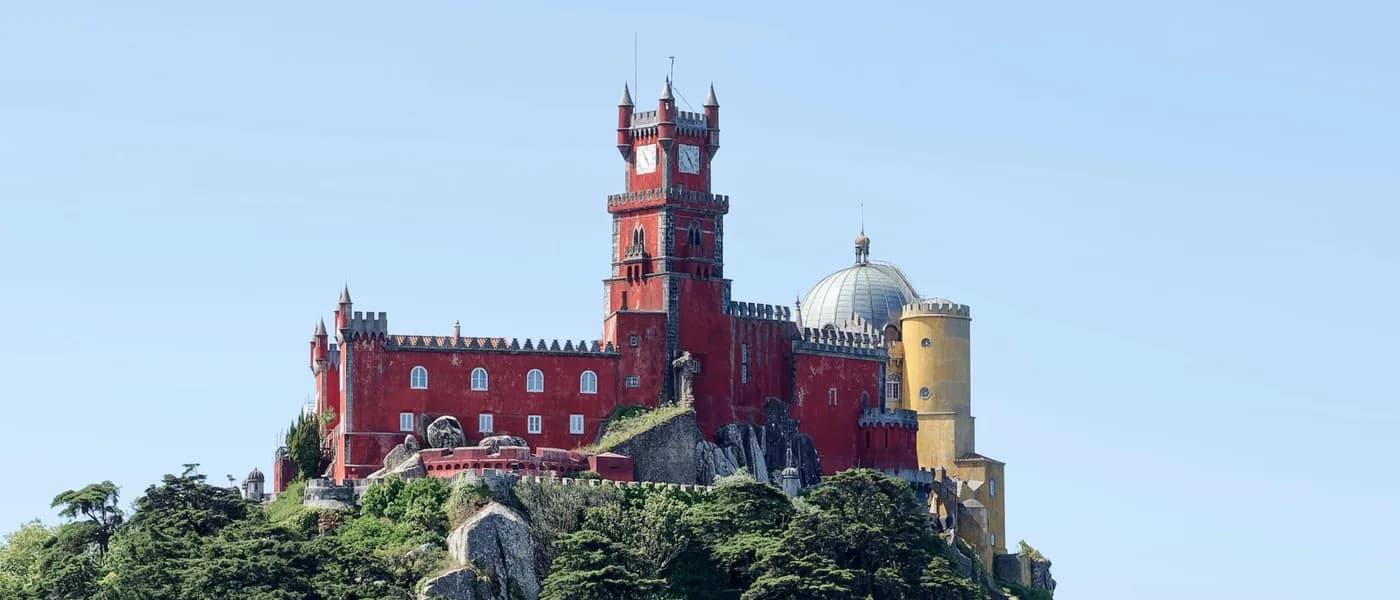
the romantic crown at the top of the hills
There is a palace in Portugal that refuses to be discreet. Burnt-yellow on one wing, blood-red on another, with Moorish towers, Manueline windows and a stone triton holding the entrance portal as if the place were literally a doorway to another world. Palácio da Pena doesn't try to fit into the landscape: it dominates it.
It was D. Fernando II, consort king and amateur painter with an eccentric eye, who transformed the ruins of a sixteenth-century Hieronymite convent into what you see today. Construction began in 1842 and never had a coherent stylistic logic, which was exactly the point. Portuguese Romanticism has its most radical monument here: a palace where the neo-Gothic, the neo-Manueline and the Moorish coexist without apologising to anyone.
Inside, it's a different story. The royal apartments preserve their late nineteenth-century decoration almost intact: German tiles, heavy furniture, Meissen porcelain, tapestries. There's a gleaming copper kitchen that looks ready to use and an Arab room lined in stucco with the ornamental density of a miniature mosque. The park surrounding the palace has kilometres of paths under dense tree cover, with species from several continents planted at D. Fernando's own initiative.
The view from the terrace over the Sintra hills, the Atlantic and, on clear days, Lisbon, explains why this summit was always strategic. Getting there on foot through the forest, instead of taking the bus, completely changes how the palace appears in front of your eyes.
the history behind the extravagance
The convent that stood on this summit before the palace belonged to the Order of Saint Jerome and was partially destroyed by the 1755 earthquake. When D. Fernando II bought it in 1838, the chapel and part of the original structure remained. Those ruins were incorporated into the new building: the old Manueline church is still there, preserved inside the larger complex.
The architect responsible for the project was Baron Wilhelm Ludwig von Eschwege, a Prussian military engineer who knew Portugal well. His influence is visible in the towers and battlements that give the palace the profile of a German medieval castle. But D. Fernando literally got his hands dirty: he left drawings, made decisions and imposed his personal taste at every stage of the work.
what you'll find
- the external colour contrast that no photograph quite prepares you for
- the royal apartments with original decoration intact, rare in Portugal
- the old Manueline chapel integrated inside the palace
- the park with exotic species and Atlantic views
- considerable crowds, especially on the terraces


