the kingdom's shield, between two worlds
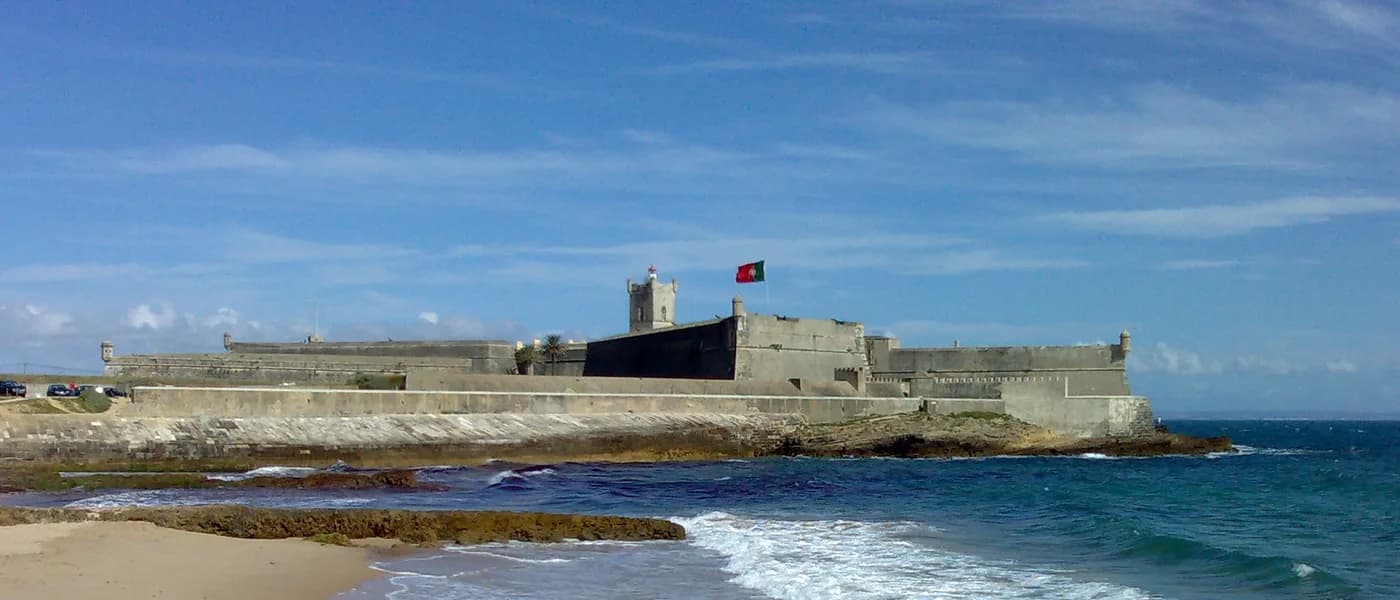
It sits at Ponta de São Gião, exactly where the Tejo opens out into the Atlantic. Anyone entering or leaving the bar of Lisboa passes right alongside it, and that was the intention. The fort was designed by Miguel de Arruda from 1553, and its near-pentagonal geometry, with ravelin, bastions and moats, made it one of the first examples of bastioned fortification in Portugal.
The Forte de São Julião da Barra worked together with the Forte do Bugio, right out there in the water, to close off the bar like scissors. No ship entered or left without passing between the two. On foggy days, seen from the river, the profile of the walls looks like the bow of a ship cutting through the estuary. The tower has a lighthouse, with 25 lights that still guide vessels today.
Today it's the official residence of the Minister of Defence. Most of the complex is in use, but there are guided visits to what can be seen: the battery esplanades, the vaulted casemates, the cistern. The scale surprises anyone who arrives unprepared.
walls with heavy memory
It was a prison for centuries, and the cells leave no doubt about the conditions of detention. The Marquis of Pombal used it to imprison the Jesuits he ordered expelled from the country, and the priest Anselmo Eckart was held here between 1762 and 1777. Before that, it withstood the forces of Philip II without falling. When it did fall, in 1807, it was through the only front that was never really its strong point: land. Junot entered by land, the British retook it months later.
The Colégio Militar was born here. In 1802 it functioned as an education college for the children of the military of the Artilharia da Corte regiment, and was the origin of an institution that still exists today.
go ready for
- the scale of the complex, which goes beyond what any photograph conveys
- vaulted casemates hosting regular cultural events
- visits by prior appointment and with guided accompaniment only
- the view towards the Bugio and the mouth of the Tejo, with 180 degrees of open horizon