a roman city under your feet, for real
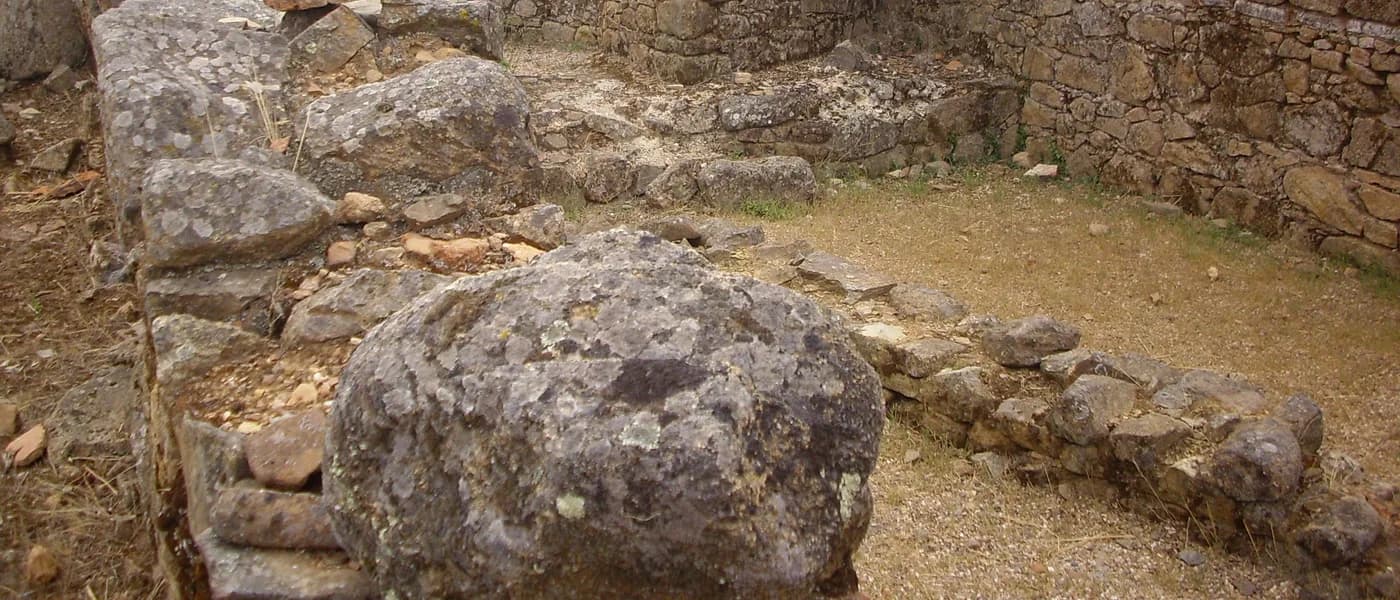
You're in a valley of the Parque Natural da Serra de São Mamede. The ruins you see around you aren't museum decoration: they're the remains of a Roman city with a forum, baths, a monumental gate and an amphitheatre. Ammaia was the capital of a huge territory, linked by Roman roads to Mérida itself, and today there are archaeologists actively digging while you visit.
The museum is housed in the Quinta do Deão, a building that sits literally on top of a Roman residential area. Part of the ruins are beneath the floor you walk on. That isn't a metaphor.
The amphitheatre identified in 2019 is the fifth known in the whole province of Lusitania, alongside Mérida, Conímbriga, Cáparra and Bobadela. It's no minor detail for a valley most people pass without stopping.
The scientific coordination is in the hands of the Universidade de Évora, and the site works as a laboratory for non-destructive archaeology methods: ground radar, remote sensing, aerial photography. You come to see the Roman past and you find the present of European archaeological research. The Serra de São Mamede closes the horizon all around, and that gives it a scale that city museums can't imitate.
what gave rise to the city
Probably founded in the time of Augustus, Ammaia grew for two concrete reasons: it stood at a crossroads of Roman roads and there was gold and quartz in the region. It gained the status of a municipium, expanded with a forum, a temple and public baths, and its administrative territory covered much of the present-day district of Portalegre, stretching into Spain as well.
The decline came in the 5th to 9th centuries. The people swapped the valley for the rock: they went to Marvão, which is still up there today. For centuries, the stones of Ammaia served as building material for churches in Portalegre and around. In 1710, one of the gateways went to the Castelo de Vide. In 1852, twenty statues were sold to England. The site was classified a National Monument in 1949, but systematic excavations only got going in 1994.
come prepared for
- open-air ruins with visible structures: wall, cardo, temple podium, baths
- a recently identified Roman amphitheatre, the fifth in Lusitania
- active research under way, not just a static display
- a collection of pieces with a rotating programme ("12 Meses, 12 Peças")
- uneven ground and open sun outside the museum building


