the excavations show you a lisbon that existed before the cathedral
Out front, two towers flank the portal and a Romanesque rose window opens at the centre. The cathedral was built in the 12th century, shortly after D. Afonso Henriques reconquered Lisbon, on the site of an old mosque. The heavy towers were part of the plan: cathedral and fortress at the same time, in a moment when the city was a frontier.
In the cloister, excavations uncovered the city's layers: below the Gothic are Roman, Arab and medieval remains, from the Iron Age to the Middle Ages. The cloister itself dates from the late 13th and early 14th century, built during the reign of D. Dinis.
Inside, the original Romanesque nave retains its massive pillars and rounded arches. It was here that Saint Anthony, born in Lisbon, is said to have been baptised: the font sits in a chapel with 18th-century tile panels showing the saint preaching to the fish. In the ambulatory, Gothic from the time of D. Afonso IV, are the tombs of the king and Queen D. Beatriz.
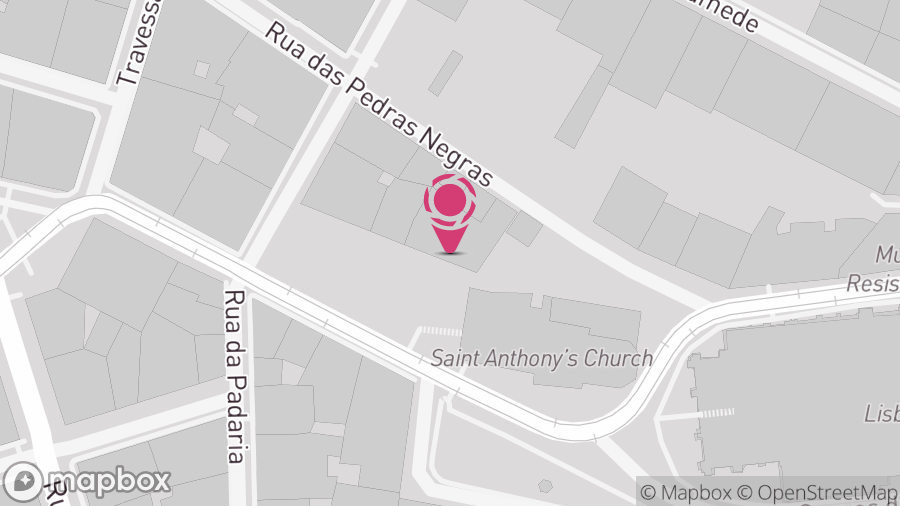
The Igreja de Santo António is a couple of steps away, on the spot where the saint was born. Above, the Castelo de São Jorge; below, Alfama and the river. The cathedral is in the middle.
what you'll find inside
- two Romanesque towers flanking the facade, with the rose window at the centre
- the original Romanesque nave, with massive pillars and rounded arches
- the baptismal font of Saint Anthony, in a chapel with 18th-century tile panels
- the Gothic ambulatory from D. Afonso IV's time, with the tombs of the king and D. Beatriz
- the archaeological excavations in the cloister: Roman, Arab and medieval remains